
Grace, mercy, and peace be with all of you from God our Father, and from our Lord and Savior Jesus Christ. Amen.
Saint Peter is trying so hard to be generous here today. You can almost hear the pride in his voice as he asks the question, because he thinks he already knows the answer and he thinks the answer is going to impress Jesus. There was a standard within the rabbinic tradition, the tradition of the rabbis around the first century with which Jesus was interacting here in our reading from Matthew’s gospel, concerning how many times you must forgive somebody for the same offense before you are no longer required to do any more. Peter had been taught by his rabbi as a young man that he is supposed to forgive three times, because after all if somebody sins against you and apologizes, and then does it again, and then does it again — three times — that’s a lot of forgiving. After three, you were done, and you could let them have it with a clear conscience. But Peter realizes that Jesus is merciful and teaches forgiveness, and so he imagines himself to be even more generous. “Well,” he thinks, “I’ll double it and add one.” So instead of three he ends up with seven, and he asks, “How many times must I forgive — as many as seven times?” And he’s thinking that’s pretty good, that’s pretty generous, that is magnanimous beyond anything the law would ever require. But of course Jesus gives his famous answer: “I say to you, not seven times, but seventy-seven times.” Or perhaps seventy times seven — either way, the number is scarcely the point. The point is that Peter was asking the wrong question entirely, because forgiveness is not a ledger with a quota to be met and then closed.
Because the human tendency, from the earliest times, is vengeance. We are people who seek revenge from the earliest moments of the book of Genesis. You do something to me, I’ll do something back to you; your family hurts my family, I find a way to hurt yours. Just in chapter four of the very first book of the Bible we find two declarations of vengeance. You know the story of Cain and Abel, how Cain, jealous of his brother Abel and his righteousness, kills his brother, and God promises that he will be avenged — if vengeance is taken on him, it will be sevenfold. But that is not enough for Cain’s descendant Lamech, the son of Methuselah, who boasts in his own personal vengeance. Where God promised sevenfold vengeance for the shedding of human blood, here comes Lamech, and he says, “If Cain is avenged sevenfold, I will be avenged seventy-sevenfold.” In other words, whatever God’s standard might be, Lamech will exceed it; whatever the limit is, he will blow past it. And remember that in ancient times the idea of an eye for an eye and a tooth for a tooth was never permission for vengeance; it was a restriction on revenge. Because instead of just an eye for an eye and a tooth for a tooth, it was this: if you hurt my eye, I’ll put out both of your eyes; if I lose a tooth through your injury, I’ll knock out all of your teeth. An eye for an eye was a limit imposed on the human appetite for cruelty.
We like to take vengeance into our own hands, and righteous anger is one of the most powerful and destructive forces in the world. We tell ourselves we are owed it, that we have earned the right to hurt back. Jesus’ command here to Peter is intended to undo what Lamech has done. Lamech wants seventy-sevenfold vengeance; Jesus commands seventy-sevenfold forgiveness. The very number that Lamech boasted in becomes the number of grace.
This is a weekend that reminds us how acutely the sins of the past can haunt our spirits. The twenty-fifth anniversary of September eleventh was this weekend, and it still produces in us feelings of sorrow, of anger, and of the desire for revenge. It is a wound that has not fully healed even after a quarter of a century. We see the pictures and the videos, and if you are above about the age of thirty you remember exactly where you were and what you felt that day when the Twin Towers and the Pentagon were attacked. And yet, at a moment when the desire for retribution runs so naturally and so strongly in the human heart, the lectionary has appointed us — appropriately, today — also to be confronted with Jesus’ teaching of forgiveness. But how can we forgive? How can we forgive with Jesus’ level of forgiveness? How could anyone possibly manage that?
Hence Jesus gives us a parable — the parable of the unforgiving servant. And the first thing to notice is that the parable is intended to make you crack a smile; it’s sort of a joke, at least at the start. It begins with the servant owing his master ten thousand talents. Now, how much money is that? Well, if you were to work as a regular laborer in the Roman Empire in the first century and you needed to earn ten thousand talents, you would be at it for roughly two hundred thousand years. It’s a cartoonishly large amount of money. It’s so much money it’s more than what Scrooge McDuck would go swimming in in his vault — and if you get that reference, it’s time for your annual prostate exam. By rough estimate, it might have been as much as a quarter of all the money in circulation in the entire Roman Empire. This is not, oh, I owe somebody ten grand. Ten grand is a large amount, but it could be repaid with hard work and discipline. This is a debt so enormous it is beyond the reach of mathematics, let alone a single laborer.
So you’re supposed to laugh about this. Because this guy gets down on his knees before his master, and what does he say? He says, “Lord, be patient with me, and I will repay you.” Sure you will, buddy — you get on that, work hard. That’s a hole you’re not going to dig out of, no matter how hard you work or how clever you are. It’s absolutely absurd, which is precisely why it’s funny. It’s sort of like the old joke: if you owe the bank a thousand dollars, you have a problem; if you owe the bank a hundred million dollars, the bank has a problem. This servant’s debt is so staggering that the problem is no longer even really his. But rather than wrath, the king does something astonishing: he forgives the whole debt. This man is pathetic — how could he get down on his knees and say he’s going to repay this? There’s no way he ever could. What profit would there be in throwing him into debtor’s prison, where he’d scarcely have any opportunity to earn back what he owes? So instead the king forgives him the entire debt, and he goes free.
But the servant didn’t realize what he had received. It did not land on him what had just happened. And when someone owed him a large but much more manageable sum of money — a hundred denarii, about a hundred days’ wages, a couple thousand bucks, a lot of money but not an inconguerable, cartoonishly large sum — there is no patience at all for that man who owed the money. There is no mercy in his heart. You see, he had received a tremendous, incalculable gift, but his heart remained stone cold. It didn’t change who he was on the inside. He remained a bookkeeper in his heart, counting what people owed him and what he owed others while utterly forgetting the mountain that had been erased on his own behalf.
It’s a similar situation in the reading from Romans today. The church in Rome had received grace and forgiveness in our Lord Jesus Christ, but they couldn’t stop passing judgment on each other. They had been forgiven everything and still found ways to hold one another’s failures up to the light. Saint Paul puts it this way: “Who are you to pass judgment on servants of another? It is before their own Lord that they stand or fall.” Instead, we are to welcome one another because God has welcomed us. Here today gathered is the church, the beloved community. You, the people of God, are a beloved community — the community of people who are not perfect but who are loved and forgiven in Jesus Christ. We’re not the ones who always get it right, but we are the ones who, for the sake of the love that Jesus gave us, come here to receive his love and to share his love with others.
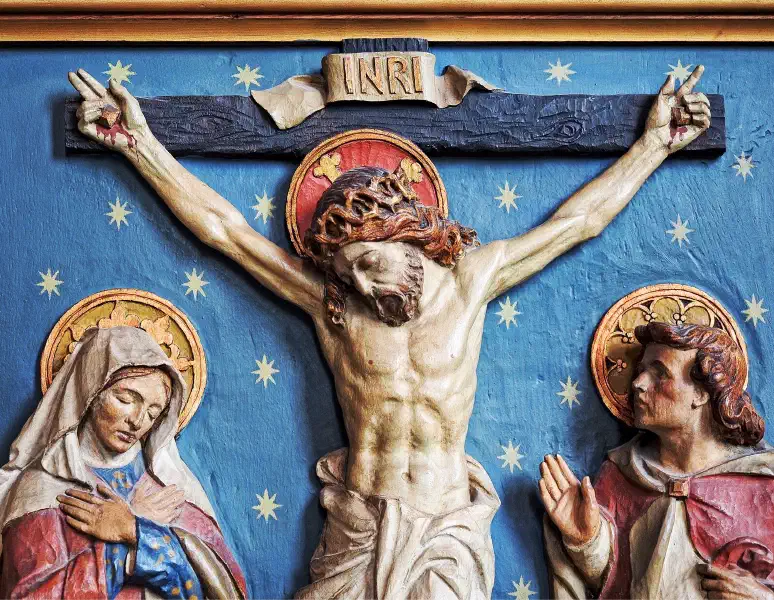
This weekend we are launching our children and youth ministries for the year, here at our Rally Day. We are going to be presenting Bibles to our three-year-olds and our third graders, blessing backpacks, and making promises — promises that our kids will be supported and encouraged in faith this year, promises that they will be taught and loved and walked with as they grow. Because the basic curriculum of the church — not just for children but for all of us — is forgiveness. Forgiveness of sins from God, because all of us are that servant who owes an inconguerable sum of money, because all of us have been forgiven an incalculable debt that we’ve incurred because of sin. And to us we hear the good news: that Jesus Christ has taken your sin far beyond your ability ever to begin to repay it, and he’s taken it with him to his cross, and it is nailed with him on the cross, and it is finished. And so you, forgiven and free, are now free to forgive others.
We are to forgive from the heart. Not forgive and forget — that’s not a biblical idea, and forgetting is often not even possible. Scripture never commands us to forget. But forgive, and release the hold that vengeance and revenge has upon our souls. People of God gathered here today, you are people who have been forgiven, forgiven in the name of Jesus Christ, and by his work upon the cross you have been forgiven everything. Now go and be forgiving to one another. That’s the good news. May you live in this good news that your sins are forgiven. May you dwell within the classroom of faith that teaches forgiveness again and again and again, and may the peace of God which surpasses all understanding keep your hearts and minds strong in Christ Jesus our Lord to life everlasting. Amen.