
Grace, mercy, and peace be with all of you from God our Father, and from our Lord and Savior Jesus the Christ. Amen.
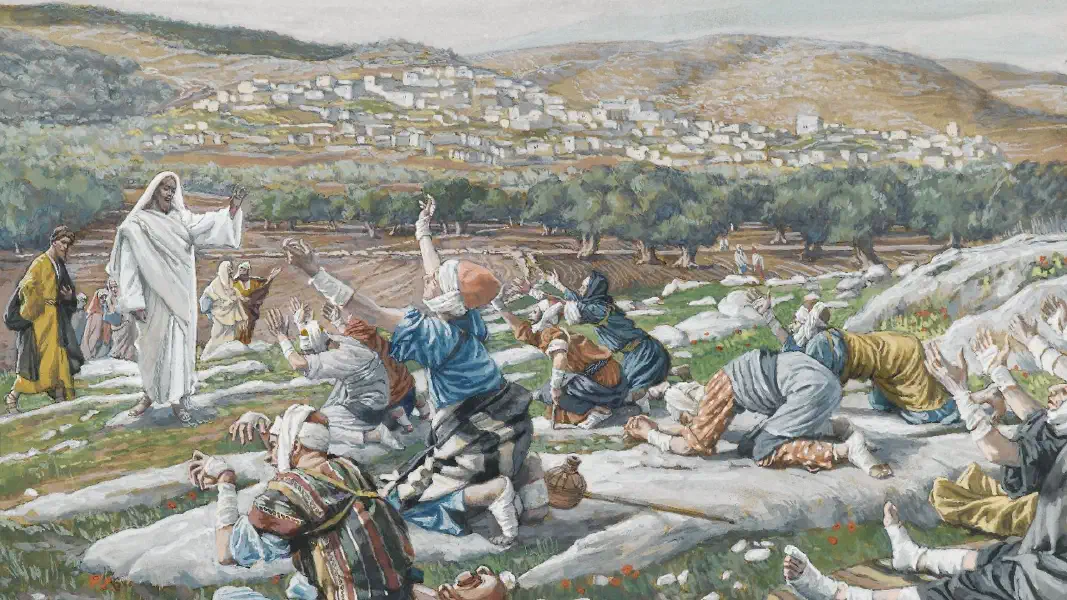
Ten men got their lives back that morning on the border road, but just one came back. We know the one man’s story, but Luke never tells us what happened to the other nine. Not a word. They vanish. They receive the blessing of forgiveness, of cleansing, of curing, and then they disappear to go, presumably show themselves to the priests and go on to live a normal life.
Jesus encounters them on the road between Samaria and Galilee, and it’s a kind of a border country area. Jesus is on his way eventually to Jerusalem, eventually heading to the cross, and he goes through this border region that nobody really wants. It’s not good land, and it sits in between two groups of people who absolutely hate each other, which is kind of ironic because they have a lot in common. The Samaritans are descendants of the people who were part of the tribes of Israel, the northern kingdom. And of course, the Jews are descendants in this time and place from those who are part of Judah and Benjamin in the southern kingdom. And so they have a lot in common. For example, they both have the Torah. They both have the first five books of the Bible, although over time the Samaritan’s copy seems to have become corrupted. And the funny thing is that the Samaritans still exist today. You can actually go visit Samaritan towns in the Holy Land even to this day, and they will argue with you about where the proper place to worship is and what the Torah really says.
So they’re traveling through this middle ground, and so you have this middle ground in which people are gathered who don’t belong in either place, and the reason for that is because they are lepers. They have a skin condition. We don’t know which skin condition that actually was. Modern-day leprosy is probably a little bit different than the skin condition that they had, but they’re in this middle area, and they’re living in the land that nobody wants, and the reason they’re there is because they are not welcome back at home. To have the tainted skin of leprosy, or more likely Hansen’s disease, is to be an outcast from society, unwelcome in any home, only fit to live among people who are unclean like you are.
So both of these groups, a mixed group of Jews and Samaritans, living together in this leper colony of sorts, these ten men come to Jesus and they do the right thing. They keep the law. Leviticus chapter 13 says that they may not come into contact with anybody, and they have to shout that they are unclean and give people plenty of chance to keep their distance because these folks are not welcome. They’re not safe to be around. They’re not safe to touch. And so they shout from a distance, Jesus, Master, have mercy on us. That’s the Jesus prayer before there was such a thing as the Jesus prayer. It’s a good prayer, and it hasn’t cost them anything.
And Jesus’ response, he doesn’t touch them. He doesn’t even pronounce them clean. He simply tells them to go to the priests and present themselves and demonstrate their cleanness. This is what Leviticus tells them to do. They’re supposed to go and get certified clean, right? The assumption is that cleaning has happened. And he just tells them, go show yourself to the priests. You’re clean, go. But he doesn’t even say they’re clean. He just says, go.
And so, having cried out to Jesus, the Master, for mercy, these men all go. They do what they’re told. Every one of them, all ten of them, pick up and head out to go show themselves to the priests, to be certified that they are able to be returned to polite society, that they are allowed to come back into towns and villages and homes. Unclean, still spotted, still ringing their bell and shouting, unclean, unclean, to make sure that people know they’re not allowed to be around them. They haven’t been certified yet. And they walk towards the priests, trusting that the command that Jesus had given them would come true in their obedience. And as they went, Luke says, they were cleansed. As they go, they are made whole and healed.
The healing happens in the middle of their obedience, on the road, and not one of them yet has had the opportunity to say thank you. They simply go and do what they have been commanded to do.
Now, it’s easy for us to think of leprosy as something a long time ago and far, far away, and thank God that that’s the case for us in our context living in southwestern Minnesota in 2026. But leprosy is not a museum disease. It still exists and is a serious problem today. The World Health Organization counted, get this, 167,000 cases of leprosy in 2025. It’s among the most neglected tropical diseases in the world. It’s curable though. The medicine has been given away for free since 1995. 17 million patients have been cured of leprosy because the medicine is available and it’s free.
But back in the time of Jesus, these men had no prospect of receiving help in the form of antibiotics. They have to put themselves entirely in the hands of Jesus Christ. This is a disease that takes fingers and faces off of people in the world. And yet they have been given their lives back. But of those 10, just one of them saw what had happened. One of them understood, and that’s actually the word that Luke uses. He saw that he was healed. All of them have had that announced to them. All of them have believed that they will be healed as they travel to go see the priests. You wouldn’t do that if you didn’t think it was actually happening. But one of the men, his eyes are open, he sees that he was healed. And he turns back and he comes back to Jesus with a loud voice and his face in the dirt.
And he gives thanks and pays homage to Jesus for saving his life. Luke is sparing with that word. Luke only uses it four times. He uses it here to see. Or rather, I’m sorry, we’re talking about thank you. He uses it here to talk about thank you. The second time is when a Pharisee in the temple, two chapters later, uses it hypocritically. “God, I thank you that I am not like those other people, you know, those bad people over there. I thank you that I’m a good person.” And then he uses it twice at the Holy Supper when Jesus takes the bread and the cup and gives thanks to God. That’s the only places where that word for thank you appears in all of the Gospel of Luke, which means that in Luke, giving thanks is what an outsider does.
Here we have the story of a Samaritan amongst a bunch of Jews, and one comes back to say thank you. A word which is rare in the Gospel of Luke, but a word then that carries extraordinary extra weight. Jesus asks this man a question. Were not ten made clean? Where are the other nine? Notice that there are two things that Jesus doesn’t do here. Two things he’s not doing. First, he’s not short of praise for this one who is a hated outsider, a Samaritan, somebody who would not be welcome even if he weren’t sick. But he’s also not auditing this man for his gratitude. All of ten of them were healed. All of the ten of them go with joy to show themselves to the priest. All ten of them are given the gift of healing and wholeness through the power of God in Jesus Christ.
He asks this question because nine of them got their skin back and they went home to their families. But one of them did better. The nine who went home got their skin back. They got their family back. Nothing bad happens to them in this story. This is not a morality tale where we say, well, you know, the one came back and he got something good and the nine went away and they got a piano dropped on them. They all got the blessing. One of them gave thanks.
Pay attention again to the words that Luke reminds us of, of Jesus. Jesus uses two different words. In verse 14, these men were cleansed. They were cleansed. They were cleaned. In verse 17, again, he says it. Were not the ten cleansed? And then two verses later, he says, to the one who has returned, your faith has made you well. A word that is far bigger than simply being clean, simply being cleansed. Your faith has made you well. Because part of wellness is acknowledging where it is that your gift has come from, acknowledging with gratitude that one who has given you so much, the man who has come to salvation. In fact, that’s the word that Jesus uses in the gospel of Luke, actually throughout the gospels, the word that Jesus uses when he’s speaking of salvation, that we have been made well. This is why we talk about Jesus as the great physician, because faith makes you well. Not just well in body, well in spirit and soul in ways that are far more important than whether we have physical health or not.
So what we have today in that same morning with that same gift, two different outcomes. Ten men are cured of their Hansen’s disease, of their leprosy. One man finds salvation. It’s not because gratitude bought the cure, by the way. The nine got the cure without it, and his gratitude didn’t buy him salvation either. But as he comes to true faith in Jesus Christ, he knows where his gift has come from, and he turns back in gratitude.
In the last year, there have been 48,000 organ transplants. Actually, 2024. And every one of them was a gift offered by that individual or their family. Nobody earns an organ. Nobody deserves an organ better than somebody else deserves an organ. Unfortunately, because there are so few, it’s necessary to sort of ration them and decide who has got the, but they’re not, it’s not on the basis of how good a person you are. If you are in need of an organ transplant, it’s on the basis of how likely that organ is to save your life and to give you a good long life into the future. That kind of salvation, that kind of gift, is what happens to us in Christ. And those who receive that kind of an organ, you know, they haven’t grown that organ themselves. The one they have was damaged or diseased. They didn’t pay for that organ. They didn’t wake up and write a check. They simply went to sleep and woke up and had new life.
So nine walk away well. One man walks away whole. Whole not just in body but in mind and spirit. The gift got there first while they were still obeying but still not grateful. And that’s what grace is. But one of them noticed and he’s remembered in his faithfulness. Even though we don’t know his name, his faithfulness echoes through history. Because he notices what God has done for him, he sees it, and he’s saved.
A woman named Sarah Josepha Hale would not stop turning back. She was a magazine editor in Philadelphia, and in 1827, she began writing that our country needed one fixed day per year to look up and notice what God has done for us. And give thanks. And so she started writing about that and then in 1846, 19 years later, she started sending letters to governors, to members of Congress, to ministers serving abroad, to Navy commanders. And she kept at that for another 36 years. In 1863, she wrote to Abraham Lincoln and reminded him that George Washington had already set the day in 1789. And so five days later, Lincoln signed a proclamation in the middle of the Civil War declaring a day of national thanksgiving, to give thanks with penitence and to pray for widows and orphans. 36 years of letters to people who often did not even bother to answer her because she believed that a nation that stops looking up forgets who fed it.
She is a picture of this 10th man on a national scale, reminding all of us that we need to not simply receive the good gifts and go with joy to enjoy them, but that we need also to look up and acknowledge and give thanks to the one who has made those gifts possible.
So as we gather today, we should look up and remember, not just remember the good gifts that God has given us, those things which we call daily bread, everything from food and water and clothing and shelter to good government and good neighbors and peaceful times, but we have to remember and give thanks to the, for, to the God who has made all these things possible for us. The nine were not villains. They’re just you and me on an ordinary Thursday. We get good news and we move on. You know, you’re having a hard time and the paycheck clears, or you have, you have a little scare and the scan comes back clean, or the kid finally calls and you were worried, or the biopsy is benign. And then we get on with our day because the day is full and there’s work to be done in the kitchen or in the office. There’s a list of people who need a meal delivered in the other room. Nothing bad will happen to us just because we don’t give thanks, but there is mercy for the one who stops and acknowledges the source of all these good things.
So come and be with me today, the tenth man. Turn around on the road and bow down before the one who has made all these good things possible for you. For he who has promised is faithful, and he gives his very life for you, to give you salvation, in Jesus’ name. Amen.